Many hotels claim to be accessible, but travelers often discover only after check-in that the room does not actually meet their mobility needs. A grab bar in the bathroom is not the same as a roll-in shower, and a “accessible” label on a booking site tells you almost nothing about door widths, bed heights or turning space. This gap between marketing and reality is exactly why accessible hotel rooms need a round of specific questions before you commit.
This guide walks you through the checks that matter: why the word “accessible” alone is not enough, which room dimensions and doorways to confirm, what to verify in the bathroom, how to assess beds and in-room equipment, and how to build a booking strategy that protects you. We also cover the questions to ask about common areas and the destination itself, and finish with a checklist you can use on your next search.
Why Accessible Hotel Rooms Need Extra Questions
The word “accessible” is not standardized in the hotel industry. A property can legally label a room accessible based on a single feature, such as a grab bar next to the toilet, while the doorway is too narrow for a wheelchair or the bathroom only contains a bathtub. From the hotel’s side, the label is technically accurate. From yours, the room may be completely unusable.
Scarcity makes the stakes higher. Most properties keep only a handful of accessible rooms, often somewhere between one and five per building. If you arrive and the room does not work, there is usually no alternative on site to move you to. A wrong booking is not an inconvenience you can fix at the front desk; it can derail an entire trip.
Why photos are not enough
Hotel photos rarely show the details that decide everything: door widths, the type of shower, bed height or the space beside the bed. A wide-angle shot of a bathroom tells you nothing about whether the shower has a flat entry. The only reliable check is to ask the hotel directly, with specific questions, and get the answers in writing. The rest of this article gives you exactly which questions to ask.
Room Dimensions and Doorways to Confirm
Door width is the single most important measurement to confirm, because nothing else matters if you cannot get through the door. Standard hotel doors are often only 60-75 cm wide, while wheelchair users typically need at least 81-90 cm of clear width. Ask for the clear width, meaning the actual opening with the door open, not the door leaf itself. Also ask about the door handle side and whether the door is heavy or spring-loaded, since both can make independent entry harder even when the opening is wide enough.
Inside the room, space matters as much as width. A wheelchair needs roughly 150 cm of turning space, so request the room dimensions and confirm there is enough room to turn beside the bed and in the entry area. A long, narrow room can technically fit a wheelchair but leave nowhere to maneuver. Ask specifically about the space between the bed and the wall or furniture, and whether furniture can be moved if you need a wider path.
Details to confirm before you book
- Thresholds: even a low 2-3 cm step at the bathroom door can block a wheelchair. Ask whether all doorways in the room are completely flat or have removable ramps.
- Floor and elevator access: ask whether the accessible room is on the ground floor or reachable by a working elevator, and what the backup plan is if the elevator is out of service during your stay.
- Bathroom door type: some accessible rooms have a sliding bathroom door, which saves space, while others have a hinged door that swings into the turning area you need.
Get the answers to these measurements in writing, ideally by email, so you have something to fall back on if the room you are assigned does not match what was promised. Verbal assurances at check-in are easy to lose in translation between front desk and housekeeping.
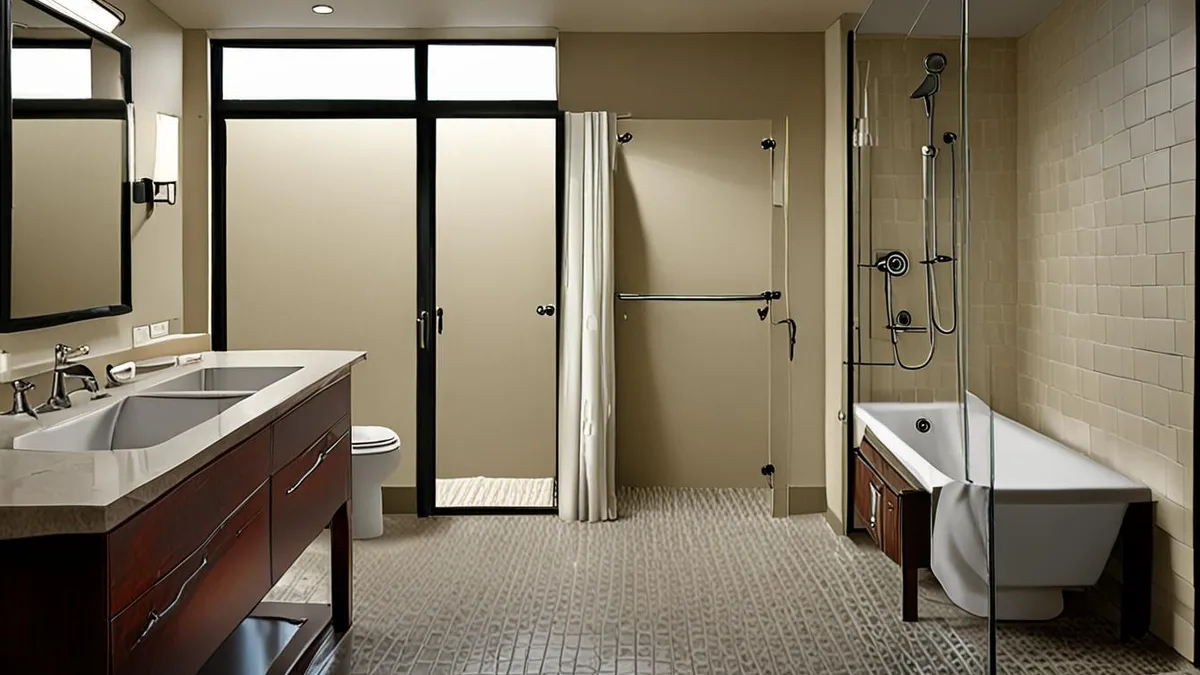
Bathroom Features: Roll-In Shower, Grab Bars and Toilet Height
The bathroom is where “accessible” labels fail most often. Many hotels market a bathtub with a grab bar as an accessible option, but roll-in showers are far less common than bathtubs marketed as accessible. Confirm the shower type explicitly: you want a true roll-in shower with a flat entry, no lip and no step. Ask the hotel to describe the entry in detail rather than just confirm the word “shower,” and get that description in writing by email so you have something to refer back to at check-in.
Once the shower type is settled, ask about the fixtures around it. A fold-down bench, a handheld showerhead and grab bars at both the toilet and the shower make the difference between a bathroom you can use independently and one you cannot. Request the toilet seat height as well, ideally 45-48 cm, and check there is clear space beside the toilet for a lateral transfer. If you travel with a care assistant, ask whether there is enough room for two people to move around comfortably.
Smaller details worth asking about
- Sink access: ask whether the sink is knee-clear underneath, so you can roll under it rather than sideways up to a vanity cabinet.
- Mirror height: a mirror mounted high above the sink may be out of view from a seated position; a tilted or lowered mirror solves this.
- Light switches and controls: confirm switches, thermostat controls and hairdryer outlets are within seated reach, typically lower on the wall rather than at standard standing height.
- Towels and storage: ask that towels and toiletries be placed within reach, since racks mounted high or deep in the bathroom can be unusable from a wheelchair.
Beds, Furniture and In-Room Equipment
The bed is where you spend the most hours, so its height deserves a direct question rather than an assumption. Accessible-friendly hotel beds usually sit 45-60 cm high, which allows a comfortable side transfer from a wheelchair. If that range is still awkward for you, ask whether the hotel offers height-adjustable beds — some properties do, but they rarely mention it on their website.
Hoists and space under the bed
If you travel with a portable hoist, confirm two things before booking. First, ask whether there is clear space under the bed frame so the hoist legs can slide underneath; a solid base or a bed pushed against a wall can make a transfer impossible. Second, ask whether the hotel can provide a hoist itself, since a few larger properties keep one on hand for guests who request it in advance.
Once the bed is sorted, think about everything you will reach from a seated position. A desk at standing height, wardrobe rails set too high or light switches placed above shoulder level can turn a well-designed room into a frustrating one. Ask specifically about the desk height, the wardrobe rail height and where the light switches and thermostat are mounted. Photos almost never show these details, so a short phone call or email is the only dependable check. If the hotel cannot answer precisely, treat that as useful information in itself.
Finally, if you are deaf or hard of hearing, ask about visual alarms and vibrating alert devices. These can include a flashing doorbell or smoke alarm and a bed shaker for waking up. Not every property stocks them, so request them when you book rather than at the front desk on arrival.
Booking Strategy for Accessible Hotel Rooms
Accessible rooms are usually the first to sell out, simply because most properties keep only a small number of them. That scarcity means a careless booking can leave you with no suitable alternative on site, so a careful strategy matters more here than for a standard room. The four steps below take a little extra time but can save you from arriving to find the room you need does not actually exist.
- Book early in high season. With so few accessible rooms per property, they disappear quickly once summer or holiday demand picks up. Reserving 2-3 months ahead means you are choosing among available rooms rather than settling for whatever is left.
- Get every feature in writing. After booking, send an email asking the hotel to confirm the specifics in a reply. A written list gives you something concrete to point to if the room you receive does not match what was promised, and it is far harder to dispute than a phone conversation.
- Call the hotel directly. Booking platforms often use inconsistent accessibility labels, so a room marked accessible on one site may not match reality. A direct call puts you in touch with staff who can physically check the room, and it gives you a contact name for any follow-up.
- Reconfirm one week before arrival. Rooms get reassigned, maintenance issues happen and staff change. A short call or email a week out catches any error while there is still time to fix it.
Booking early also tends to work in your favor on price, and the same timing logic applies to any hotel stay, accessible or not. If you want to sharpen your general timing, our guide to when to book hotels for better rates covers how far ahead to reserve in different situations. Pair that timing with the written confirmations above and you will have both the right room and the right rate.
Questions About Common Areas and the Destination
An accessible room is only half the stay. If you cannot reach the restaurant, use the restroom by the pool or get through the front door without help, the room itself matters little. Many hotels focus their accessibility efforts on the guest rooms and overlook the spaces guests actually move through all day. Ask the hotel directly about its common areas, one by one, and get specifics rather than a general yes. Then look one step further at the streets and transit around the property, because the most well-equipped hotel can still sit in a location that is difficult to leave.
- Restaurant and dining areas: ask whether the entrance is step-free and whether tables are spaced so a wheelchair can pull up comfortably, not just squeeze between fixed seating. Breakfast rooms are sometimes located on a mezzanine or down a few steps from the lobby, which is easy to miss until you arrive.
- Pool, spa and gym: confirm each one is reachable without steps and ask whether there is a pool lift or a step-free entry, since these are often skipped even in otherwise accessible hotels.
- Accessible restrooms in common areas: a property may have one adapted restroom near the lobby but none on the floor where the spa or restaurant sits, so ask about each floor you plan to use.
- The entrance route: a grand main door with steps and a discreet side entrance with a ramp or lift is a common setup, so ask exactly how a wheelchair guest actually gets in, and whether that side entrance is staffed or locked outside certain hours.
The destination itself deserves the same scrutiny, especially in older European districts where cobblestones, steep hills and old transit stops can make even short trips exhausting. A hotel may sit barely a few hundred meters from a major attraction, yet the route between them can be impractical for a wheelchair. Research whether nearby sidewalks have curb cuts and whether the closest transit stop is wheelchair-friendly, and check the current accessibility details with the local transit operator. If you are planning a city stay and want help picking a location, our guide to the best areas to stay in Lisbon for first-time visitors breaks down how different neighborhoods compare for getting around.
Wrapping Up Your Accessible Room Checklist
A room labeled accessible is not automatically a room that works for you. As this article has shown, hotels vary widely in what that word actually means, so the essentials need direct confirmation: door width, turning space, shower type and bed height. Ask before you book, not after you arrive, because discovering a problem at check-in usually leaves you with no alternative on site.
Two habits protect you best. First, get every promised feature confirmed in writing by email, so a verbal promise at booking cannot quietly disappear. Second, book early, ideally 2-3 months ahead in high season, since accessible rooms are few and sell out first. Then complete the picture by checking the common areas and the destination itself before you commit. If this checklist helped you plan a trip, leave a comment or share the article with a fellow traveler.