You’ve found a villa that promises accessible luxury, only to arrive and discover the “roll-in pool” actually has two steep steps and a narrow ledge. It’s one of the most common disappointments for wheelchair users booking private villas, because the word “accessible” in a listing often describes the villa itself, not the pool entry. True step-free pools are far rarer than the marketing suggests.
This guide walks you through what genuine step-free access looks like, from zero-entry and ramped pools to hoists and transfer benches, and the exact questions to ask before you book. We’ll also compare destinations and seasons where accessible villas are easier to find, break down the real costs including carers and equipment rental, and show you how to verify everything in writing so your deposit is protected. By the end, you’ll know how to tell a true roll-in entry from a clever photo angle.
What ‘Step-Free’ Really Means for Villa Pools
The term “step-free” gets used loosely, so it helps to know the three entry types you’ll actually encounter. A zero-entry pool, sometimes called a beach-style entry, slopes gradually from the pool deck into the water the way a beach does, with no edge or lip to cross. A ramped entry uses a constructed ramp, usually with handrails, to get you below the waterline. A transfer platform, by contrast, is simply a submerged ledge or step, sometimes with one or two shallow steps beside it, designed for someone who can lower themselves in from a seated position.
The gradient that makes a roll-in genuinely workable
For a zero-entry edge or ramp to be usable without being pushed or carried, slope matters more than anything else. Common accessible-design standards call for a maximum gradient of 1:12, meaning one unit of rise for every twelve units of length. Steeper than that, and self-propelling up the slope becomes hard or unsafe, and even assisted entry gets precarious when the surface is wet. Also ask about entry depth: zero-entry edges typically start at 0 and deepen gradually to around 1.2 m, which tells you how far in you can roll before you’re out of your depth.
Here’s the catch: when a listing title says “accessible villa,” it usually refers to features like a ground-floor bedroom, wide doorways or a roll-in shower. The pool is often an afterthought, and a single step into the water is enough to make the whole “accessible” label meaningless for a wheelchair user. Always treat the pool entry as a separate question that needs its own answer.
Pool Entry Types Compared: Which Suits Your Mobility
Not every step-free or near-step-free entry suits every traveler, so match the entry type to your mobility rather than chasing the “best” option on paper. A power wheelchair user needs a completely different setup from someone who walks short distances with a cane, and a traveler staying with two carers has options a solo guest doesn’t. Be honest with yourself about how you actually move through water, how you get from seated to standing, and how much help you want on a given day.
A zero-entry edge is the gold standard for independent access. You can walk in gradually, or roll in using a waterproof pool wheelchair, which is essential because a standard power or manual chair cannot go in the water. The shallow approach also means the water warms quickly near the edge, and for longer therapeutic sessions look for pools kept around 28-30°C, which suits limited-mobility guests far better than a brisk lap pool. A ramped entry with handrails works well for confident walkers and for assisted transfers, since the rails give both of you something to hold. Hoists and transfer benches open up pools that have no sloped entry at all, but they add a human and mechanical dependency you should understand before booking.
- Zero-entry edge: confirm the surface underfoot or under the wheels, because smooth tile, pebbled finishes and non-slip textured coatings behave very differently for wheels and bare feet when wet.
- Ramped entry with handrails: check rail height on both sides and whether the grip is a warm, non-slip material, since metal rails in full sun can be too hot to hold and single-sided rails limit assisted transfers.
- Pool hoists: ask exactly who operates the hoist, whether guests may use it independently, and whether it remains installed at the pool throughout your stay or is stored away and brought out on request.
- Transfer benches: find out where the bench sits relative to the water line and whether a strong assistant is realistically needed to complete the transfer safely.
Questions to Ask Before You Book a Roll-In Pool
Vague answers like “yes, it’s accessible” won’t protect you if the pool turns out to have steps. Before any money changes hands, put the specifics in writing. Ask the owner or agent for the exact entry dimensions: the width of the zero-entry or ramp, the gradient stated as a ratio such as 1:12, and the water depth at the entry point. A owner who has actually measured their pool can answer this within a day; one who cannot is telling you something.
Photos matter just as much, but only the right kind. A wide shot of a beautiful pool tells you nothing about the entry, so request recent photos or a short video walkthrough filmed from the deck, moving toward and into the water, showing the edge, the slope and the surrounding paving. A few minutes of video reveals lip heights, slippery-looking surfaces and gaps that still photos are cropped to hide. There’s a fuller process for vetting listings in our guide on how to check a villa listing before paying a deposit.
The pool is only half the journey, too. The route from your bedroom and bathroom to the water must be step-free as well, and that’s where many otherwise suitable villas fail.
- Route details to request: door widths measured at the narrowest point, threshold heights at each sliding door or terrace step, and whether any garden path between villa and pool uses gravel, stepping stones or a lip at the pool deck.
- Hoist logistics: if a hoist is offered, ask whether it requires staff assembly or operation each time, and how quickly staff can respond when you want to swim, since a hoist two buildings away with one caretaker on site can mean long waits.
- Depth check: confirm the water depth where the entry meets the pool, so you know whether you can reach comfortable swimming depth or whether you’ll need assistance past the shallow shelf.
Destinations and Seasons Where Accessible Villas Are Easier to Find
If your goal is a true roll-in pool, location matters more than you might expect. Some destinations build villas on flat, single-level plots where step-free design comes naturally, while others fight gravity at every turn. Choosing the right region can save you weeks of frustrating searches.
Where single-level layouts are common
Coastal Bali and Sri Lanka are strong starting points. Many beachside villas there are built on one level, with pool terraces close to bedroom level and gentle transitions between indoor and outdoor space. That makes genuinely flat routes from your room to the water far more achievable than in hillside properties. Bali’s south coast is at its driest from December to March, which suits travelers who want reliable pool weather during that window. For Sri Lanka, the best coastal areas shift with the monsoon seasons, so it pays to match your region to your travel months; our guide to Sri Lanka villas by coastal area and season breaks this down in detail.
Europe: Mallorca and mainland Spain
Mallorca and mainland Spain generally offer stronger accessible-tourism infrastructure than smaller Greek islands. You will find more villa owners who understand roll-in requirements, better equipment rental networks, and easier airport transfers with adapted vehicles. Aim for May-June or September: the weather is still warm enough for long pool sessions, but you avoid the peak crowds and the highest rates of July and August.
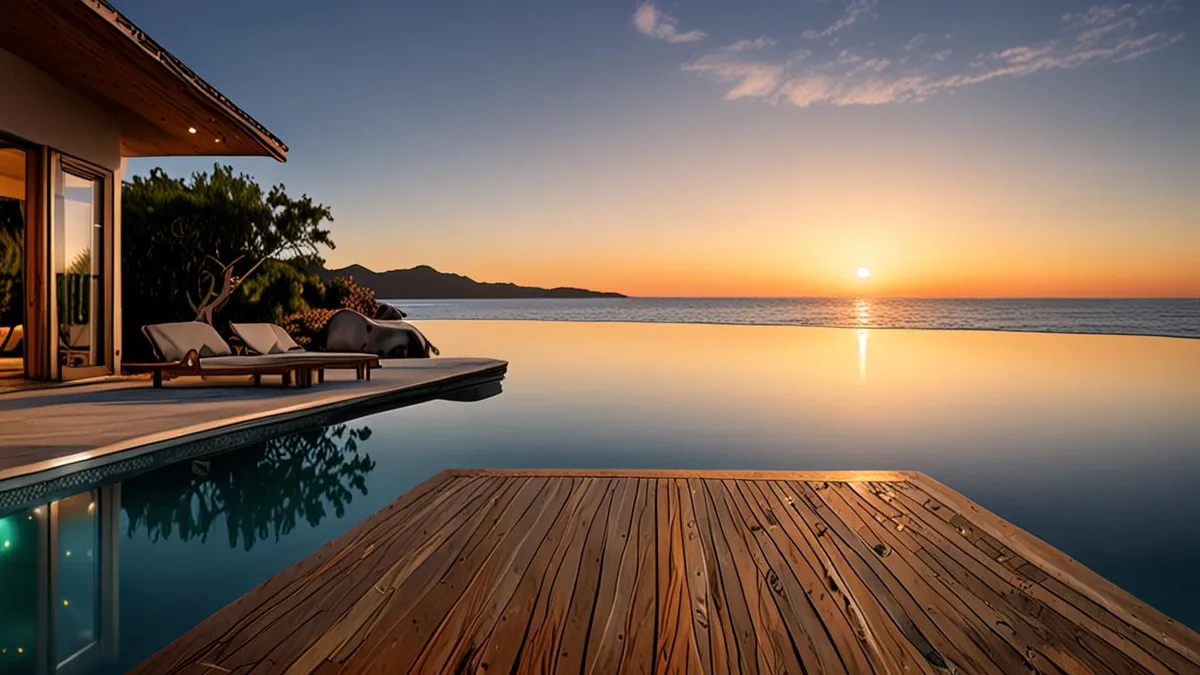
On the other hand, be realistic about cliff-top destinations such as Santorini. The dramatic caldera views come from steep terrain, and many luxury properties there involve staircases, terraced levels, or cable-car access from the port. Despite five-star price tags, true roll-in pool access is rare. A beautiful photo of an infinity pool tells you nothing about the twelve steps between the bedroom and the water, so verify every detail before committing.
Budgeting: What Accessible Villas and Extra Support Cost
Accessible villas with genuine step-free pool access are scarce. Only a small share of private villa listings offer true roll-in entry, and that limited supply shapes the entire budget. Plan for higher costs than a comparable standard villa, plus the support and equipment that make the trip work day to day.
The price premium
As a planning figure, expect accessible villas to run 20-40% more expensive than comparable standard villas in the same area. The premium reflects the small number of properly designed properties and the demand from travelers who genuinely need them. Rather than treating this as an add-on, build it into your baseline budget from the start so the final numbers don’t surprise you.
Support staff and equipment
If you need help with transfers, dressing, or daily care, budget for hired carers or personal assistants. In many destinations these are quoted per day for multi-hour shifts, and rates vary widely by country and experience level. In Bali, where many villas come with staff included, it helps to understand the local staffing market first; our breakdown of what private chefs and housekeepers cost in Bali villas gives you a realistic reference point for adding extra support staff to a booking.
Equipment is the third line item. A waterproof pool wheelchair, a portable hoist, or a transfer bench may need to be rented for the week if the villa doesn’t provide them. Ask the villa manager or a local accessible-travel operator about availability before you book, since rental stock in smaller destinations can be limited. Get quotes in writing, confirm delivery and pickup arrangements, and check whether the villa has secure storage for the equipment between uses.
Finally, keep a small contingency for the unexpected: an extra day of carer support if flights shift, or a replacement rental if something arrives damaged. A buffer of roughly 10% on top of your accessible-travel costs is a sensible rule of thumb for a smooth trip.
Verifying the Villa and Protecting Your Booking
Photos can be misleading, and “accessible” means different things to different owners. A villa can be advertised as wheelchair friendly while the pool itself has a raised lip, a single step, or a steep slope that no one thought to mention. The safest approach is to verify everything in writing before money changes hands, and to keep a local contact who can double-check the details when you’re close to arrival. Treat the process like a checklist rather than a conversation, and put every promise into an email thread you can refer back to.
- Get written confirmation before the deposit. Ask the owner or agent to state in writing that the pool entry is step-free, including the entry type and the route from the bedroom and bathroom. A written summary protects you far better than a phone call you can’t reference later.
- Agree on what happens if the villa doesn’t match the description. Before paying, confirm in writing whether a misdescribed pool entry triggers a refund, a comparable rebooking, or compensation. Knowing the remedy in advance avoids a stressful negotiation on arrival day.
- Request proof, not promises. Ask for close-up images of the pool entry itself, the thresholds, and the doors along the route, taken from the angle you’d actually approach it. Distance shots of the pool alone tell you nothing about the entry.
- Confirm any hoist logistics. If a pool hoist is offered, ask who operates it, whether it stays installed throughout your stay, and how quickly staff can respond if you need it. A hoist that requires assembly by off-site staff is a very different proposition from one that’s ready to use.
- Use a villa manager as a local checkpoint. Ask the manager to re-verify the access details shortly before your arrival, ideally with fresh images of the entry and route. This catches last-minute changes such as maintenance work, added furniture, or a temporary step.
A few extra emails before booking take far less effort than dealing with an inaccessible pool once you’ve landed. Owners who answer specific questions clearly and in writing are usually the ones whose villas genuinely deliver, while vague or evasive replies are a signal to keep searching. If an agent resists putting details in writing, that reluctance itself is useful information. Keep copies of every confirmation, and bring them with you so that any misunderstanding on arrival can be resolved quickly and fairly.
Finding Your Roll-In Pool Villa: Key Takeaways
The disappointment most wheelchair users know too well is a villa labeled “accessible” that turns out to have one or two steps down to the water. A genuinely roll-in-friendly pool means either a zero-entry edge, where depths typically range from 0 to about 1.2 m, or a ramp built to a gradient of 1:12 or gentler. Anything less is a ramp for walking, not swimming.
Because a small fraction of villa listings worldwide offer true step-free pool access, the ones that do get booked early. Treat your search like hunting for a rare property type rather than a standard vacation rental, and start conversations with villa owners or agents well before your travel dates firm up. Water temperature matters here too: pools held at 28-30°C make longer therapeutic sessions realistic for guests with limited mobility, which is worth raising when you shortlist options.
If you have stayed somewhere that delivered genuine roll-in access, share the property and what made it work in the comments, or pass this article along to someone planning their own accessible trip. Firsthand recommendations are often the fastest route to a villa that actually matches its description.