Most resort websites say remarkably little about what they offer deaf and hard-of-hearing guests. You might find a single line about “accessible rooms” buried in a policy page, with no mention of visual alarms, text capabilities, or whether the front desk can actually communicate with you. That guesswork makes it hard to know what you’re paying for before you arrive.
This guide walks through what you can realistically expect: what a genuinely accessible room usually includes, how resort services like dining and activities should accommodate you, and how to research a property before committing your money. You’ll also find booking strategies, since accessible rooms make up only a small share of most resorts’ inventories and disappear early, plus practical notes on costs, destinations where communication tends to be easier, and how to wrap up your stay smoothly. The goal is simple: book with confidence instead of crossing your fingers.
What Deaf and Hard-of-Hearing Guests Should Expect in an Accessible Room
When a resort advertises an “accessible room,” many travelers assume that covers every type of disability. In practice, most accessible rooms are designed around wheelchair users, with roll-in showers and grab bars, and very little thought given to hearing access. A truly deaf-friendly room is a different thing entirely, and it starts with safety equipment.
The single most important feature is a visual alarm system. Instead of relying on sound, the room has strobe lights that flash when the fire alarm sounds or when someone knocks at the door. Without this, a deaf guest could sleep through an emergency evacuation signal, which is exactly the kind of gap generic “accessible” labels hide. If a resort’s accessible room has no strobes, it is not deaf-friendly, whatever the brochure says.
What usually comes in a hearing access kit
Many resorts that don’t have purpose-built deaf-friendly rooms keep a portable kit in storage and deliver it to a standard room on request. A typical kit includes a visual doorbell that flashes a light when pressed, a bed shaker alarm clock that vibrates the mattress to wake you, a telephone that supports text communication such as a TTY device, and a television with closed captions enabled. These kits are usually loaned at no charge, but the stock is limited, so it pays to ask exactly what the resort has before you arrive.
One point of confusion: assistive listening devices, like amplified phones or personal amplifiers, are designed for hard-of-hearing guests who use some residual hearing. They won’t help a fully deaf guest at all. If you travel with a deaf family member and a hard-of-hearing one, clarify which devices serve which need, since the kit a resort offers may only cover one of you.
Because hearing access features vary enormously between properties, treat any room description as a starting point rather than a guarantee. Ask specifically about strobes and kit contents, and get the answer in writing so there are no surprises at check-in.
Resort Services Beyond the Room: Front Desk, Dining and Activities
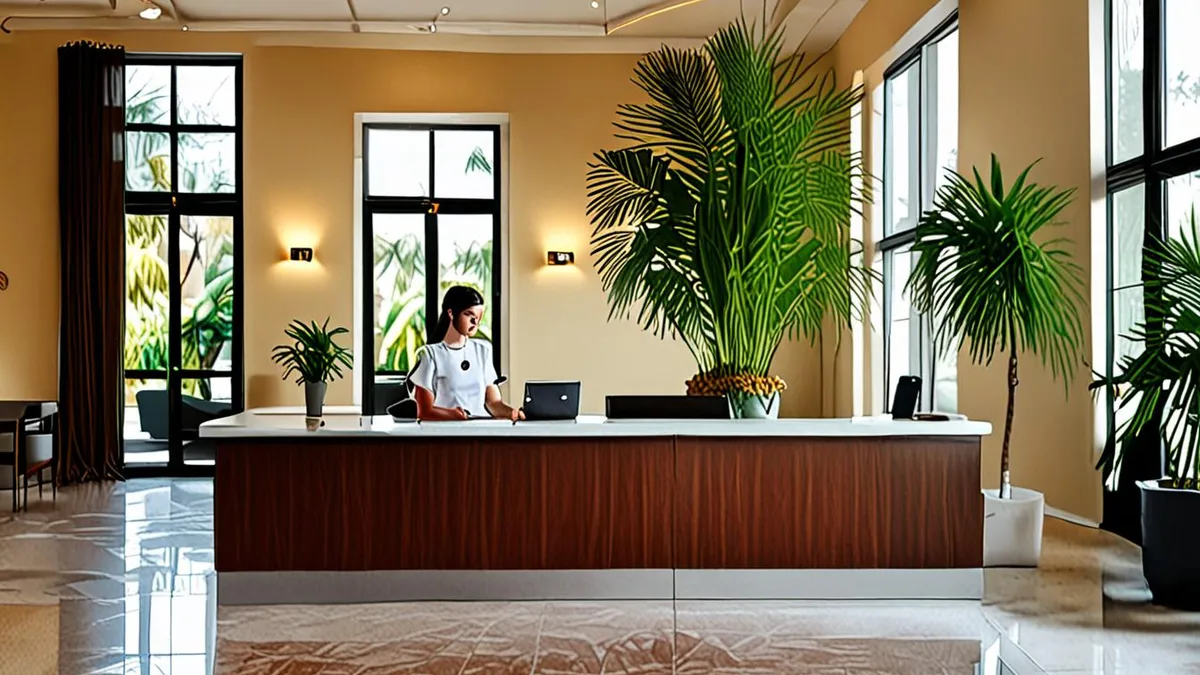
The front desk is your first test of how deaf-friendly a resort really is. When you arrive, ask directly how staff can communicate with you: can they type on a tablet, write notes, or text your room? Most modern properties can do at least one of these, but few train every shift on it. If the person at the desk seems unsure, ask them to note your preferred method in your guest profile so you don’t repeat the request with every new shift.
Dining, shows and activities
Restaurants are usually the easiest part of a resort stay.Menus are often already written, and buffet layouts let you point at what you want. For table service, it helps to request a table where your server’s face is well lit and visible, so any conversation can be lipread. If the resort runs evening shows or entertainment, ask in advance whether captions can be arranged, even as a simple printed script of the dialogue or songs.
Spas, kids clubs and water sports deserve extra attention because safety briefings are usually spoken. Give these outlets advance notice so instructors can demonstrate rules visually, use written forms, or pair you with a staff member who can confirm instructions face to face. A scuba or snorkeling briefing you only half-understood is not a briefing you want.
Skip the wake-up call entirely
Wake-up calls are nearly useless for deaf guests, since a ringing phone wakes nobody. Rely instead on a bed shaker alarm, which resorts with deaf-friendly kits often loan for free, or a strong vibration alarm app on your phone placed under your pillow. Test whichever you use the first night rather than trusting it on the morning of an early tour or flight.
How to Research Whether a Resort Is Truly Deaf-Friendly
Most resort websites have an accessibility page, but read it carefully and you’ll notice a problem: the features listed usually focus on mobility. Roll-in showers, grab bars, and wide doorways get detailed descriptions, while hearing access is lucky to get a single mention of “closed captions on TV.” That doesn’t mean the property lacks deaf-friendly features — it often means the website simply doesn’t distinguish between the two types of access. A room can be fully wheelchair accessible yet have no visual fire alarm at all.
The fastest way to cut through the vagueness is to contact the resort directly and ask three specific questions:
- Do the accessible rooms have visual alarms? Ask specifically about strobe alerts for fire, smoke, and door knocks — not just “an alarm is available.” A standard audible alarm tells you nothing about deaf access.
- How do staff communicate with deaf guests? The answer should mention written notes, tablet typing, or text messaging. If the reservation agent hesitates or says “our staff are very friendly,” that’s a red flag.
- What captioning exists on property? This covers in-room TV captions plus whether shows, presentations, or dining venues offer any captioned or written alternatives.
Email tends to work better than phone here, since reservation agents may not know the answers offhand and can forward written questions to someone who does. When you read reviews, look specifically for ones written by deaf or hard-of-hearing travelers — they’ll tell you whether the visual alarm actually worked, or whether the “accessible room” turned out to be a standard room with a kit delivered an hour after check-in. For a broader method of seeing past polished marketing copy, it helps to compare resorts using the details that actually matter rather than the photos.
Property type matters too. Larger chain resorts and recently built properties are far more likely to have visual alarms and alert kits wired in or stocked on-site, because newer construction often follows accessibility codes that include hearing accommodations. Small, older boutique properties frequently retrofit nothing and rely on goodwill. Since accessible rooms are typically only around 1-5% of a resort’s inventory, a property that has them built in from the start is worth prioritizing during your search.
Booking Strategy: Securing the Right Room and Services
Deaf-friendly rooms are scarce, and once they’re gone, they’re gone. Because accessible rooms typically make up only a small slice of a resort’s inventory, timing and paperwork matter more here than in an ordinary booking. A clear, written trail protects you if anything gets lost between the reservation desk and housekeeping, and it gives you something concrete to point to at check-in if a promise hasn’t been kept.
- Book two to three months ahead. This window gives you a realistic shot at one of the limited rooms with built-in visual alarms, or at least a reservation date that lets the resort install a loaner kit before you arrive.
- State your needs in writing at booking. List exactly what you require, such as a strobe fire alarm, visual door alert and captioned TV, so it attaches to your reservation record from day one.
- Reconfirm one to two weeks before arrival. A short email or text asking the resort to verify the room and kit are ready catches mistakes while there’s still time to fix them.
- Get the specific features confirmed in writing. “An accessible room” is not enough; ask for confirmation that your room has the visual alarm and communication equipment you listed.
- Use email or text for every request. Written channels usually get faster, more precise replies than phone calls, and they give you a record you can refer to at check-in.
One extra tip while you’re making requests: ask for a ground-floor room or one near the elevator. That simplifies daily logistics, especially if you’re also traveling with mobility needs or heavy luggage, and it can be added to the same written confirmation without any extra back-and-forth.
It also helps to keep all your correspondence in one place, whether that’s a dedicated email folder or a simple note on your phone. If a front desk agent changes mid-week or your reservation is transferred between systems, a tidy paper trail makes it far easier to get things put right quickly.
Finally, save the name of the person who confirms your room details. A named contact, even a general one like the accessibility coordinator, gives you a direct line for follow-up questions and makes reconfirming before arrival much smoother.
Costs and Extras: What Accessibility Should and Shouldn’t Cost
The good news is that most accessibility features for deaf and hard-of-hearing guests cost nothing extra. Resorts in many countries are expected to provide basic communication aids as part of normal service, so treat them as something you’re entitled to request, not a luxury add-on. Knowing where the line sits between “should be free” and “worth budgeting for” helps you plan an honest budget.
Start by asking what the resort supplies. Visual alert kits, including a strobe doorbell, bed shaker and text-capable phone, are often loaned free on request, and accessible rooms are usually priced the same as comparable standard rooms rather than at a premium. If a property ever quotes you more for the same room type because it’s accessible, ask questions before accepting.
- Portable backup devices. If the resort can’t provide a kit, a travel-sized bed shaker or a smartphone vibration alarm app can fill the gap; budget for one if you travel often.
- Text-capable phone plans. If you’re heading abroad, check whether your plan covers texting at your destination, since text messaging may become your main channel with the front desk.
- All-inclusive meal plans. They reduce the number of outside restaurant interactions where staff may be less prepared, and you can read more about the trade-offs in what a week at an all-inclusive resort really costs.
Before you pay a deposit, email the resort a short list of the aids you need and ask which items they provide on site. Their answer tells you exactly what, if anything, to budget for yourself.
Destination Matters: Where Communication Is Easiest
Where you book matters almost as much as which room you book. A resort’s communication setup depends heavily on local building standards, staff training culture and how the property was constructed, so the same brand name can deliver very different experiences in different places.
Resorts in major English-speaking destinations more commonly have trained staff and built-in accessible rooms, partly because accessibility regulations tend to be well established there. That translates into front desks used to written communication, restaurants familiar with captioning requests and rooms that already include visual alarms rather than loaner kits.
Property type and location
Large hotel zone resorts, like the high-rise clusters you’ll find when comparing the hotel zone against Playa del Carmen, tend to hold more accessible inventory than boutique beach properties. More rooms means more chances that at least one has the features you need, plus deeper staff rosters to cover requests.
Remote overwater bungalows and small island properties are the opposite case. Many were built without visual alarm systems at all, and some can’t retrofit them easily, so check directly before booking rather than assuming a luxury price tag includes accessibility.
Getting there
Don’t forget the journey itself. For transfers and airport pickups, arrange text-based driver communication in advance, either through the resort’s transfer desk or the transfer company directly, so a missed phone call doesn’t leave you standing at arrivals unsure where your ride is.
Wrapping Up Your Deaf-Friendly Resort Stay
If you came here wondering why resort websites tell you so little about deaf-friendly rooms and services, the answer is simple: you usually have to ask, and you have to ask in writing. A generic “accessible” label often means mobility features only. What you actually want is confirmation of visual alarms, a bed shaker, text-capable communication options and closed captioning.
The strategy that works is straightforward. Book two to three months ahead, put every request in writing at booking, and reconfirm by email or text one to two weeks before arrival. Get the specific room features confirmed in writing, not just a vague promise. Research the destination and property type carefully, since smaller and more remote resorts often fall short on built-in features. If this guide helped you plan your trip, leave a comment or share it with a fellow traveler.