Traveling with teenagers is a different ballgame from traveling with small children. Teens want their own space, their own screen time and, above all, a door between them and their parents. Yet most families end up booking the cheapest option on the resort website, only to discover that resort rooms for teens and parents often means one shared room with zero separation and a week of frayed nerves.
The problem is that room categories are genuinely confusing. What counts as a “family room” at one resort is a cramped alcove at another, and the difference between a suite, connecting rooms and two separate bookings can swing your price by hundreds per night. This guide breaks down why standard rooms rarely work with teens, compares connecting rooms, family suites and the two-standard-room workaround, and walks through how to book the right configuration. We’ll also look at how shared resort spaces can ease the pressure, and help you choose the setup that fits your family and your budget.
Why Standard Rooms Fail Families With Teenagers
Picture the typical standard resort room: around 25 to 35 square meters, two double beds, one bathroom. Everyone sleeps, dresses, argues and gets ready in the same space. There is no door between the sleeping areas, which means a teen watching videos on their phone at 11 pm keeps a parent awake, and a parent getting dressed at 6 am wakes up the whole room. For a couple of nights it’s survivable. For a week or more, it wears everyone down.
The sofa bed problem
Many families try to solve the space issue with a room that includes a sofa bed. Here’s the catch: rooms with a sofa bed suit children up to about age 12. Teens over about 12 rarely accept a pull-out setup, and honestly, who can blame them? A sofa bed is often uncomfortable, creaks every time someone rolls over, and requires being made up and folded away each day. What was meant as a practical compromise usually means arguments rather than rest, and everyone starts the day already annoyed with each other.
One bathroom, four people
The real bottleneck is the bathroom. One bathroom for four people, all of whom need showers and mirrors at roughly the same time, creates a morning queue that sets the tone for the whole day. By day three, someone is brushing their teeth in the sink while someone else is waiting in a towel. It’s these small daily frictions, not any single big issue, that make a standard room the weakest choice for families with teenagers.
Connecting Rooms: Maximum Privacy at a Premium
Connecting rooms are the gold standard for family privacy: two separate rooms joined by an internal door. Parents get their own room, bathroom and TV; teens get theirs. You keep the door open during the day for that reassuring sense of togetherness, then close it at night. Everyone sleeps in a real bed, on their own schedule, with their own light switches. It’s the closest you can get to separate holidays while still being one household.
What connecting rooms cost
The trade-off is price. Expect to pay around 1.5 to 2 times the price of one standard room for the pair. That said, two standard rooms can still undercut a suite at the same resort, so the premium isn’t always as steep as it looks on a rate sheet. Some resorts also offer family rates or small discounts on the second room, so it’s worth asking when you enquire.
The guarantee problem
Here’s the part that catches families out every year: connecting rooms are never guaranteed unless confirmed in writing. “We’ll do our best” is not a confirmation, and resorts routinely reallocate rooms when occupancy is tight. Request the connecting configuration at the time of booking, get it confirmed by email, and then reconfirm 2 to 3 weeks before arrival when the reservations team can actually see its room allocation. If the written confirmation never arrives, treat the connecting door as a bonus rather than a plan, and have a fallback in mind, such as two adjacent rooms on the same floor.
Family Suites and Two-Bedroom Units
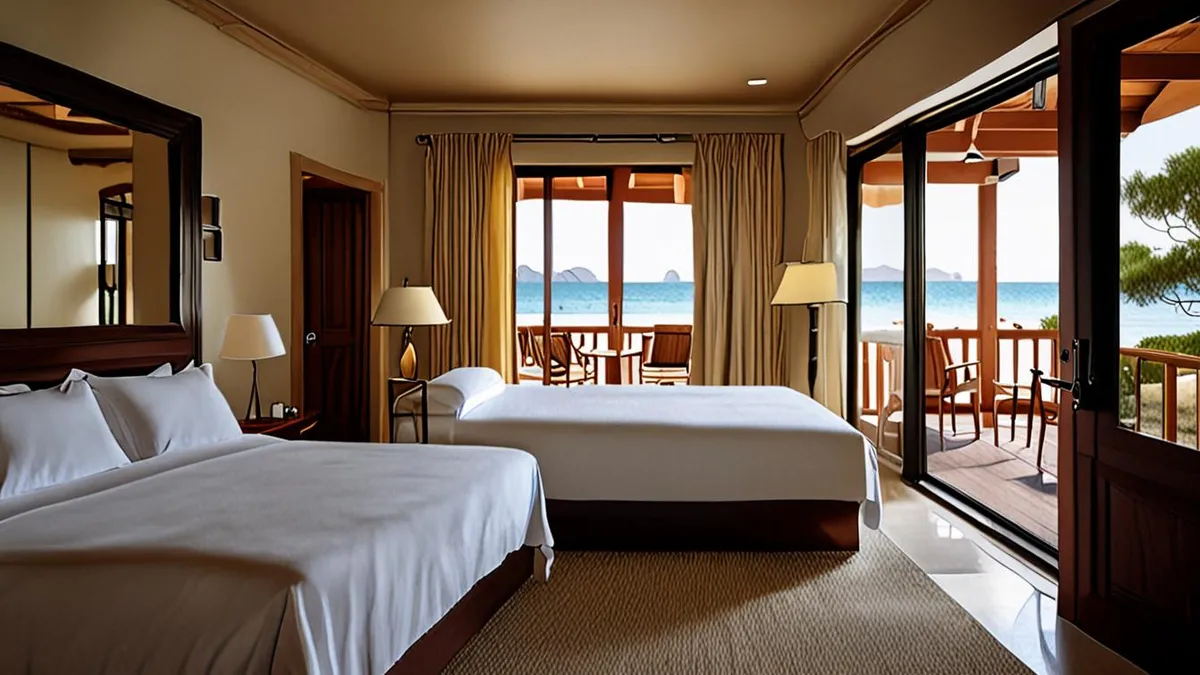
Family suites and two-bedroom units are the middle path between a cramped standard room and the cost of connecting rooms. Suites typically run 50 to 80 square meters and offer a separate bedroom for the parents plus a second sleeping area or a second bedroom for the teens. In the better layouts, that second space is a genuine room with its own door, which gives everyone a real measure of privacy within one booking.
What you pay and what you gain
Expect to pay roughly 30 to 60 percent above the standard room rate for a suite at the same resort. In exchange, you get practical advantages that connecting rooms can’t offer: one bill, one housekeeping schedule, and a shared living space where the family can actually hang out together in the evening rather than sitting on separate beds. For many families, that common area becomes the best part of the room, a place to eat room-service dinner, play cards or watch something together.
Read the description carefully
Before you book, check whether the “second bedroom” is a real room with a door or just an alcove with a curtain or sofa bed. The difference matters enormously with teenagers, who generally need a real bed and a space they can close off. Resort websites are often vague about this, so email the resort directly and ask for the exact layout, including whether the second bedroom has a window and a door. A suite that photographs beautifully can turn out to be one large room with a partition, and no curtain is going to convince a 15-year-old they have their own bedroom.
Budget Workaround: Two Standard Rooms Instead of One Suite
Here is the workaround experienced family travelers use most often: skip the suite entirely and book two standard rooms at the same resort. Two separate standard rooms often cost less than one large family suite, and in many cases they give you even more privacy than a suite, because each room has its own door, bathroom and TV with no shared living space in between.
For parents of teenagers, the biggest trade-off is losing the connecting door. That matters far less with teens than with young children. A parent of a toddler wants to hear the cot from the next bed; a parent of a 15-year-old mostly wants everyone to have their own space and a bathroom to themselves. Two separate rooms deliver exactly that, and texting each other across the hall replaces the internal door for anything urgent.
How to make two separate rooms work
When you book two rooms separately, the risk is ending up on different floors or at opposite ends of the resort. Ask for rooms on the same floor and close together at the time of booking, then note that request on both reservations. If you book through a site rather than directly, call the resort a few weeks before arrival to reconfirm the request. It is not a guarantee, but early, specific requests are far more likely to be honored than last-minute ones.
One practical tip: if the resort assigns rooms at check-in, arrive early in the day and ask in person. Front desk teams can usually see the floor plan and will accommodate a “same floor, neighboring rooms” request when inventory allows.
How to Book the Right Configuration
Choosing between a suite, connecting rooms or two separate rooms is only half the job. The other half is booking it correctly, because family room categories sell out first and descriptions on booking sites are often vague, outdated or written to flatter the property. A few careful steps at the booking stage will save you from most of the unpleasant surprises at check-in, and they take less than an hour of your time.
- Book early. Aim for 3 to 6 months ahead if you are traveling in high season. Family categories, especially two-bedroom units and connecting rooms, are the first room types to sell out, and late bookers are usually left choosing between a cramped standard room and an overpriced leftover.
- Email the resort directly. Don’t rely on the booking site description. Ask specific questions in writing: Is the second bedroom a separate enclosed space or just an alcove off the living area? How many bathrooms are there, and does each have a shower? What are the actual bed types in each sleeping area? Is the connecting door guaranteed or merely “requested”? Keep the reply as your record.
- Reconfirm connecting doors before arrival. If a connecting door is central to your plan, request it at booking and reconfirm it in writing a couple of weeks before you travel.
- Compare total costs, not room rates. Price the same stay three ways: a suite, connecting rooms, and a suite on an all-inclusive plan. Meal plans change the math significantly, so it helps to understand how half board, full board and all-inclusive plans really compare before you commit, since an all-inclusive suite can occasionally beat two à la carte rooms on total price.
Whichever configuration wins on paper, put the details in your own notes: bed types, bathroom count, floor level and any written confirmation you received. If anything differs when you arrive, you will want that record in hand before you unpack and long before you start arguing at the front desk with tired teenagers in tow.
Beyond the Room: Shared Spaces That Ease Privacy Pressure
However you configure your rooms, the reality is that a family spends far less time in the room than the booking process suggests. Most of the day happens at the pool, on the water or out on excursions, and that is exactly where the privacy pressure of a shared room eases up. Teens who spend the afternoon with friends at the pool are far less likely to squabble over space in the evening.
Resort pools and water sports give teenagers a genuine taste of independence while staying inside a safe, contained environment. A 14-year-old who spends the day between the pool, the swim-up bar area (soft drinks only, in most family resorts) and the volleyball game comes back to the room tired and happy, which is the best outcome a parent can ask for on a beach holiday.
Larger resorts add another layer of relief: organized programs. If you want to understand what structured childcare and teen activities actually involve, ages they cover and what they typically cost, our guide to kids clubs at resorts: ages, activities and costs breaks it down in detail.
- Teen programs at larger resorts: many big family resorts run dedicated sessions for ages around 13 to 17, from beach sports to evening socials, giving teens a peer group and parents a few genuinely free hours.
- Water sports and equipment rental: kayaks, paddleboards and snorkel gear, often included or available for a fee, keep teens active and away from their phones for stretches at a time.
- A balcony or terrace: even on a standard room, outdoor space effectively adds a second “room” where a parent can read in the morning while the teen sleeps in, without paying for a higher category.
- Evening entertainment venues: shows, outdoor movie nights and live music give the whole family a neutral meeting point after dinner, so nobody is stuck in the room by 8 p.m.
Think of the room as a base camp rather than the destination. When the shared spaces do their job, even a modest room setup feels far more comfortable than the square meters suggest.
Choosing the Right Setup for Your Family
The cheapest room type usually delivers the least privacy, which is exactly what parents with teenagers need most. If separation is your priority, connecting rooms offer the most privacy at 1.5 to 2 times the standard room cost, with everyone getting their own bathroom and a door between spaces.
Family suites cost 30 to 60 percent more than a standard room but keep everyone under one booking with a shared living space, which suits families who want time together as well as apart. Two standard rooms can be the cheapest route to privacy, and teens rarely miss the connecting door. Whichever option you lean toward, booking 3 to 6 months out secures the best choice of family categories in high season. Has this helped you plan your next resort stay? Leave a comment or share this article with another family planning their trip.